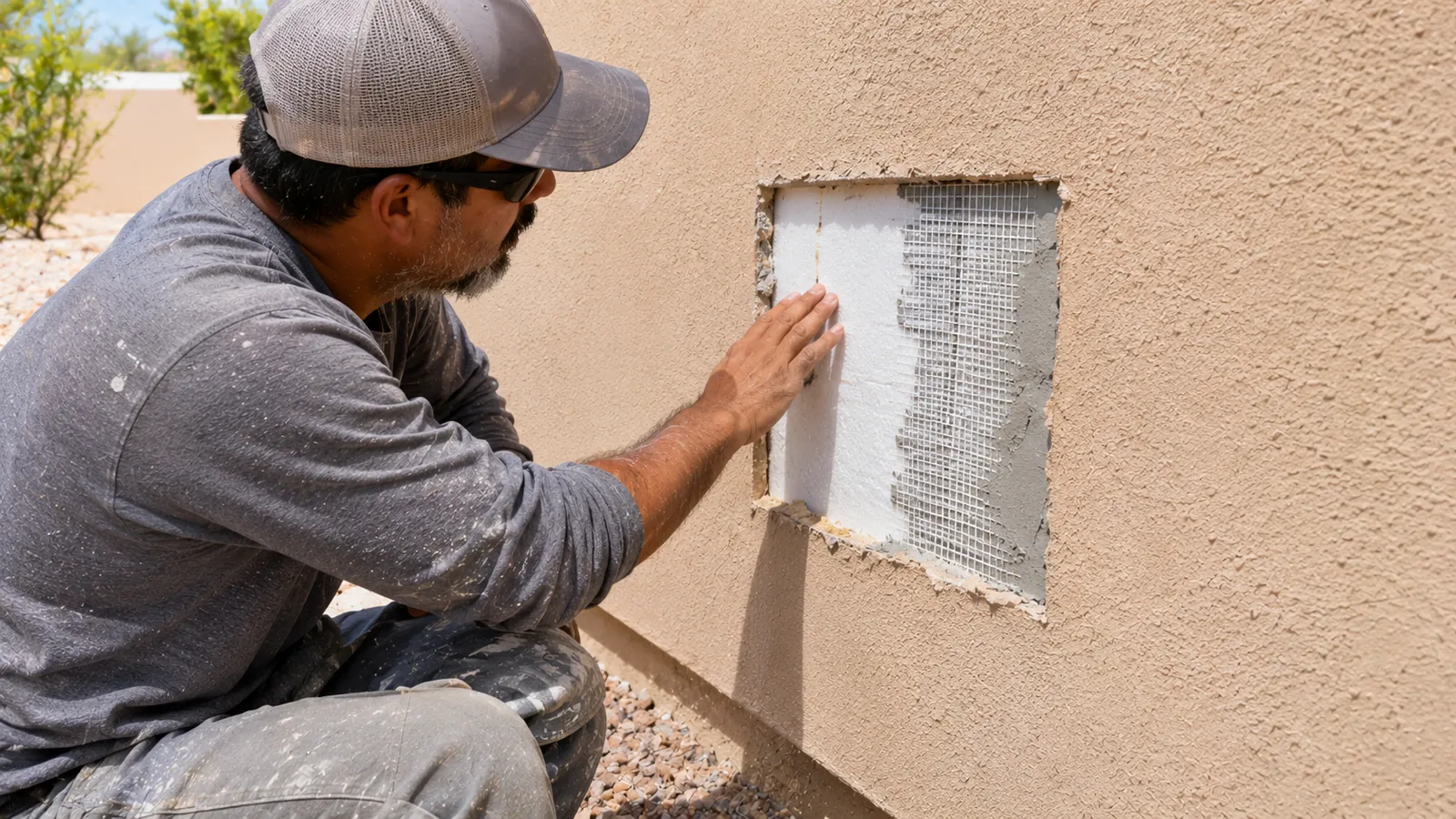
Is your wall synthetic?
A few clues: synthetic and EIFS walls often have a slightly softer, more even color and a finish that feels a bit plastic rather than gritty. EIFS sounds hollow when tapped and may dent with firm pressure, because there's foam board behind it. Many Albuquerque homes built from the 1990s on have an acrylic finish over a cement base, and some commercial-style homes have full EIFS. We'll confirm what you have when we look.
Acrylic finish over cement stucco
This is the most common "synthetic stucco" around town. The base is regular cement stucco; only the finish is acrylic. Cracks and damage in the base are repaired with cement materials, but the finish has to be patched and recoated with compatible acrylic so it bonds and flexes the same way.
EIFS: foam board, mesh and finish
EIFS uses insulation board attached to the wall, a base coat with embedded fiberglass mesh, and an acrylic finish. It insulates well and resists cracking, but it's softer and easier to puncture, and it depends on proper sealant joints and flashing to keep water out.
Common EIFS repairs we do:
- Holes and dents from impacts, hail or removed fixtures
- Failed sealant joints around windows, doors and penetrations
- Delaminated finish and base coat
- Water-damaged areas where foam and sheathing need replacing
- Missing or damaged trim and edge wraps at the base
How we repair EIFS
Damaged areas are cut out cleanly. If the sheathing behind is wet or soft, we replace it and let the area dry. New foam board is fit to the opening, rasped flush, and covered with base coat and new mesh lapped over the existing mesh so the repair is tied into the wall. The finish is then matched for texture and color. Sealant joints at windows and penetrations are replaced with the right backer and sealant.
Don't let anyone put cement on it
A rigid cement patch on EIFS or an acrylic finish won't move with the wall and will crack around its edges, letting water in. If someone has done that to your house, we'll cut it out and redo it properly. Our traditional vs. synthetic guide goes deeper on the differences.
Questions we hear
Is EIFS bad?
Not when it's installed and maintained correctly. Problems come from water getting behind it through failed joints and flashing, which is why those details matter so much.
Can EIFS be patched invisibly?
With careful texture and color matching, yes in most cases. On faded walls, recoating to a corner gives the most uniform look.
Can you convert EIFS to traditional stucco?
Yes, by removing the EIFS and building a traditional stucco system. It's a bigger project we'd quote after an inspection.